


Syllabus: GS3/Infrastructure; Environment
Context
- Recently, a Bench of the National Green Tribunal (NGT) cleared the way for the Great Nicobar Island mega-infrastructure project, noting that ‘considering the strategic importance’ of it and ‘other relevant considerations’.
About the Great Nicobar Project
- It is a large-scale infrastructure initiative conceived by NITI Aayog, formally called as the Great Nicobar Island Development Project.
- It is implemented through the Andaman and Nicobar Islands Integrated Development Corporation (ANIIDC).
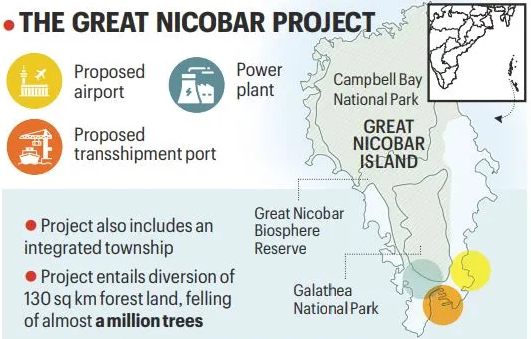
- It aims to transform Great Nicobar into a strategic economic and maritime hub.
- The project involves diversion of forest land and large-scale infrastructure development, raising environmental concerns.
- Key Components:
- International Container Transshipment Terminal (ICTT) at Galathea Bay;
- Greenfield international airport (civil and military use);
- Integrated township for phased population growth;
- 450-MVA gas and solar-based power plant.
- Strategic Significance:
- Located near the Malacca Strait, a key global shipping route.
- Intended to strengthen India’s maritime trade capacity.
- Enhances India’s defence and geopolitical presence in the Indo-Pacific region.
About Great Nicobar
- It is the southernmost island of India, part of the Nicobar group of islands in the Union Territory of Andaman and Nicobar Islands.
- It lies close to the Malacca Strait, one of the world’s busiest maritime trade routes.
- Indira Point, India’s southernmost tip, is located here.
- It is a part of a UNESCO-recognized Biosphere Reserve.
- It is ecologically fragile and seismically sensitive (Zone V).
Petitions and Allegations Before NGT
- The project relied on limited baseline data, violating the Island Coastal Regulation Zone (ICRZ) Notification, 2019.
- Around 700 hectares allegedly fell within ecologically sensitive or prohibited ICRZ areas.
- There was non-compliance with the NGT’s 2023 order directing a revisit of the Environmental Clearance (EC).
- Other Concerns:
- Potential impact on coral reefs, turtle nesting sites, and biodiversity.
- Risks due to seismic and tsunami vulnerability (2004 tsunami impact).
- Concerns over rights and livelihoods of Shompen and Nicobarese communities.
- The NGT disposed of these petitions with its latest ruling.
Issues Examined by the Tribunal & Its Environmental Clearance
- Protection of Coral Reefs: The NGT concluded that no coral reefs exist within the core project area, based on submissions from the Zoological Survey of India (ZSI).
- Scattered coral formations, if present, will be translocated as per scientific recommendations.
- MoEF has been directed to ensure coral protection and regeneration using proven scientific methods.
- Baseline Environmental Data: NGT relied on findings from a High-Powered Committee (HPC) headed by former Environment Secretary, which revisited the clearance in compliance with the NGT’s April 2023 order.
- Compliance with ICRZ Norms: The NGT concluded that ‘no part of the project’ falls within prohibited ICRZ areas.
- Portions of port infrastructure that may fall within CRZ-1A and CRZ-1B areas under the proposed master plan would be excluded in the revised plan.
- The Tribunal stressed that the conditions of the ICRZ Notification cannot be ignored and must be strictly adhered to.
- Environmental Safeguards and Conditions: The NGT noted that the environmental clearance contains specific safeguards, including protection measures for Leatherback sea turtles, Nicobar megapode, saltwater crocodiles, robber crabs, Nicobar macaques and other endemic bird species.
- Shoreline and Coastal Protection Measures: The Tribunal directed the MoEF to ensure that:
- Construction activities, including foreshore development, do not cause erosion or adverse shoreline changes.
- Sandy beaches are preserved, as they are crucial nesting sites for turtles and birds.
- The island’s shoreline is protected to prevent ecological degradation.
About National Green Tribunal (NGT)
- It is a specialized judicial body to handle environmental disputes related to environmental protection, conservation of forests, natural resources, and enforcement of legal rights relating to the environment in India.
- Establishment:
- Created under the National Green Tribunal Act, 2010
- Replaced the National Environment Appellate Authority
- Headquarters: New Delhi
- Zonal Benches: Pune (West), Bhopal (Central), Chennai (South), Kolkata (East)
Jurisdiction
- The NGT has jurisdiction over civil cases relating to substantial environmental questions under laws such as:
- The Water (Prevention and Control of Pollution) Act, 1974;
- The Water (Prevention and Control of Pollution) Cess Act, 1977;
- The Forest (Conservation) Act, 1980;
- The Air (Prevention and Control of Pollution) Act, 1981;
- The Environment (Protection) Act, 1986;
- The Public Liability Insurance Act, 1991;
- The Biological Diversity Act, 2002.
- Decisions of the Tribunal are binding.
Institutional Strengths
- Application of the ‘Polluter Pays’ and ‘Precautionary’ principles;
- Dedicated environmental expertise (Judicial & Expert Members);
- Time-bound disposal (ideally within six months);
- Power to provide relief, compensation, and restoration.
Previous article
Market Borrowing and Municipal Readiness in India
